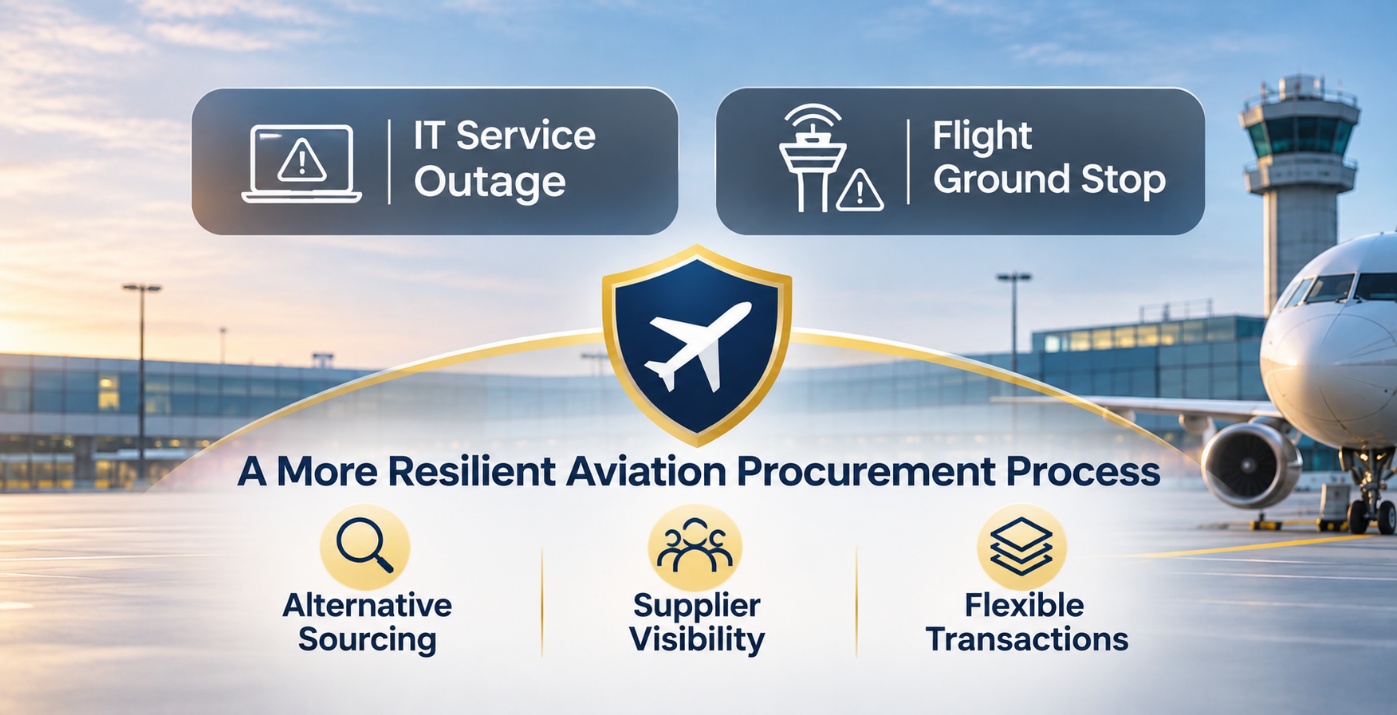
Recent technology service interruptions and flight disruptions have highlighted the importance of business continuity across the aviation industry.
For airlines, Maintenance, Repair and Overhaul (MRO) providers, and aircraft parts suppliers, these events offer a timely reminder that operational resilience depends on reliable communication, alternative sourcing channels, supplier visibility and flexible procurement processes.
As aviation becomes increasingly interconnected, maintaining alternative ways to source aircraft parts, contact suppliers and manage transactions is an important part of supply chain risk management.
What Is Aviation Supply Chain Resilience?
Aviation supply chain resilience is the ability of airlines, MRO providers and suppliers to maintain or restore essential sourcing, procurement and logistics activities during unexpected disruptions.
It relies on diversified supplier networks, accessible inventory information, alternative communication channels and adaptable purchasing processes.
Rather than depending entirely on a single system or sourcing channel, resilient procurement teams maintain multiple options to respond when normal operations are interrupted.
Recent Disruptions Highlight the Importance of Business Continuity
In November 2026, a widespread Microsoft 365 service interruption affected email and business collaboration applications used by organizations worldwide. The Guardian.
Separately, the U.S. Federal Aviation Administration (FAA) temporarily suspended flight departures nationwide following telecommunications issues affecting air traffic control operations. Reuters.
At the time of reporting, Microsoft and U.S. officials indicated that there was no evidence connecting the two incidents. Anadolu Agency.
Although different in nature, both events provide examples of how interruptions to critical services can affect interconnected business and transportation activities.
For aviation procurement professionals, they reinforce the importance of preparing alternative communication, sourcing and coordination arrangements.
How Can Technology Disruptions Affect Aviation Procurement?
Aircraft parts procurement depends on timely coordination between buyers, suppliers, maintenance organizations and logistics providers.
When essential services become unavailable, procurement teams may encounter:
- Communication delays: RFQs, quotations and purchase order confirmations may take longer to process.
- Limited supplier access: Buyers may need alternative ways to identify and contact potential suppliers.
- Logistics interruptions: Flight delays and cancellations can affect time-sensitive shipments, including Aircraft on Ground (AOG) requirements.
- Transaction bottlenecks: Reliance on email exchanges, disconnected spreadsheets or individual systems can complicate purchasing activities.
These challenges demonstrate why aviation procurement resilience requires both digital efficiency and operational flexibility.
Five Ways to Build a More Resilient Aviation Procurement Process
1. Maintain alternative sourcing channels
Avoid relying entirely on a single sourcing platform or supplier network. Complementary aircraft parts sourcing platforms can provide additional supplier discovery options when established channels are unavailable. Our guide to alternative aircraft parts sourcing covers the practical steps.
2. Improve global supplier and inventory visibility
Access to searchable aircraft parts inventories across multiple suppliers can help procurement teams identify alternative sources and respond to urgent requirements. That visibility is only useful when inventory data is current.
3. Enable direct supplier communication
Access to supplier contact information allows buyers to communicate directly and coordinate requirements through alternative channels when necessary.
4. Adopt flexible procurement workflows
Structured RFQs, quotation comparisons, purchase orders and transaction documentation improve coordination and traceability while supporting more adaptable purchasing processes.
5. Establish practical business continuity procedures
Alternative communication methods, accessible critical records and clearly defined escalation procedures help organizations prepare for unexpected interruptions.
Practical Example: Sourcing an Urgent Aircraft Component
Consider an MRO organization that urgently requires an aircraft component but cannot access its usual sourcing channel.
Rather than depending on a single supplier network, its procurement team could use an alternative aircraft parts sourcing platform to:
- Search for the required part across additional supplier inventories.
- Identify potential suppliers and obtain available contact information.
- Request and compare quotations based on availability, lead time and commercial conditions.
- Coordinate the purchase and maintain supporting transaction documentation.
This approach does not eliminate operational disruptions, but it provides additional sourcing options and reduces dependence on a single procurement channel.
How PartsCollab Supports Aviation Procurement Resilience
PartsCollab is an AI-powered aviation procurement and collaboration platform designed to improve supplier discovery, sourcing flexibility and transaction management.
With more than 3.47 million searchable aircraft parts listings across registered organizations and an extended supplier data network, PartsCollab provides an additional sourcing channel that complements existing procurement and enterprise systems.
Beyond parts searches, procurement teams can access available supplier contact information, establish direct communication when needed, and manage RFQs, quotations, purchase orders and supporting transaction documentation through a structured digital workspace.
By combining supplier discovery with practical transaction management, PartsCollab helps aviation organizations expand sourcing opportunities, improve procurement visibility and coordinate purchasing activities more efficiently.
PartsCollab can serve as a complementary sourcing and procurement workspace, providing additional options when organizations need to adapt their normal procurement processes.
Like any digital platform, its availability depends on underlying infrastructure and connectivity. Effective business continuity therefore also requires independent contingency arrangements.
Frequently Asked Questions
How can airlines and MROs reduce procurement disruptions?
Airlines and MROs can improve procurement resilience by maintaining multiple qualified supplier relationships, increasing inventory visibility, establishing alternative communication channels and implementing practical business continuity procedures.
Can alternative aircraft parts sourcing platforms improve procurement resilience?
Yes. Complementary sourcing platforms can help procurement teams identify additional suppliers, access available contact information and manage purchasing activities through alternative workflows. Their effectiveness during disruptions depends on platform availability, supplier responsiveness and appropriate contingency arrangements.
Conclusion: Resilience Requires Flexibility
Recent technology and flight disruptions reinforce an important principle: digitalization alone does not guarantee business continuity.
For aviation organizations, building resilience means maintaining the supplier relationships, information visibility and operational flexibility needed to respond when circumstances change.
A resilient aviation supply chain is not one that never faces disruption, but one that retains the visibility, connections and flexibility to respond when disruption occurs.
Explore how PartsCollab helps aviation professionals expand sourcing opportunities, connect with suppliers and streamline procurement collaboration, or book a demo with our team.
Sources and Further Reading
- Reuters — U.S. Flight Operations Resume Following FAA Ground Stop, November 13, 2026
- The Guardian — Microsoft 365 Service Disruption, November 13, 2026
- Anadolu Agency — Microsoft Says No Indication FAA Ground Stop Was Linked to Its Services
Editorial disclaimer: This article is provided for general industry information and discussion. References to third-party organizations and publicly reported events are included solely for informational purposes and do not imply any affiliation, sponsorship or endorsement. All trademarks remain the property of their respective owners.

