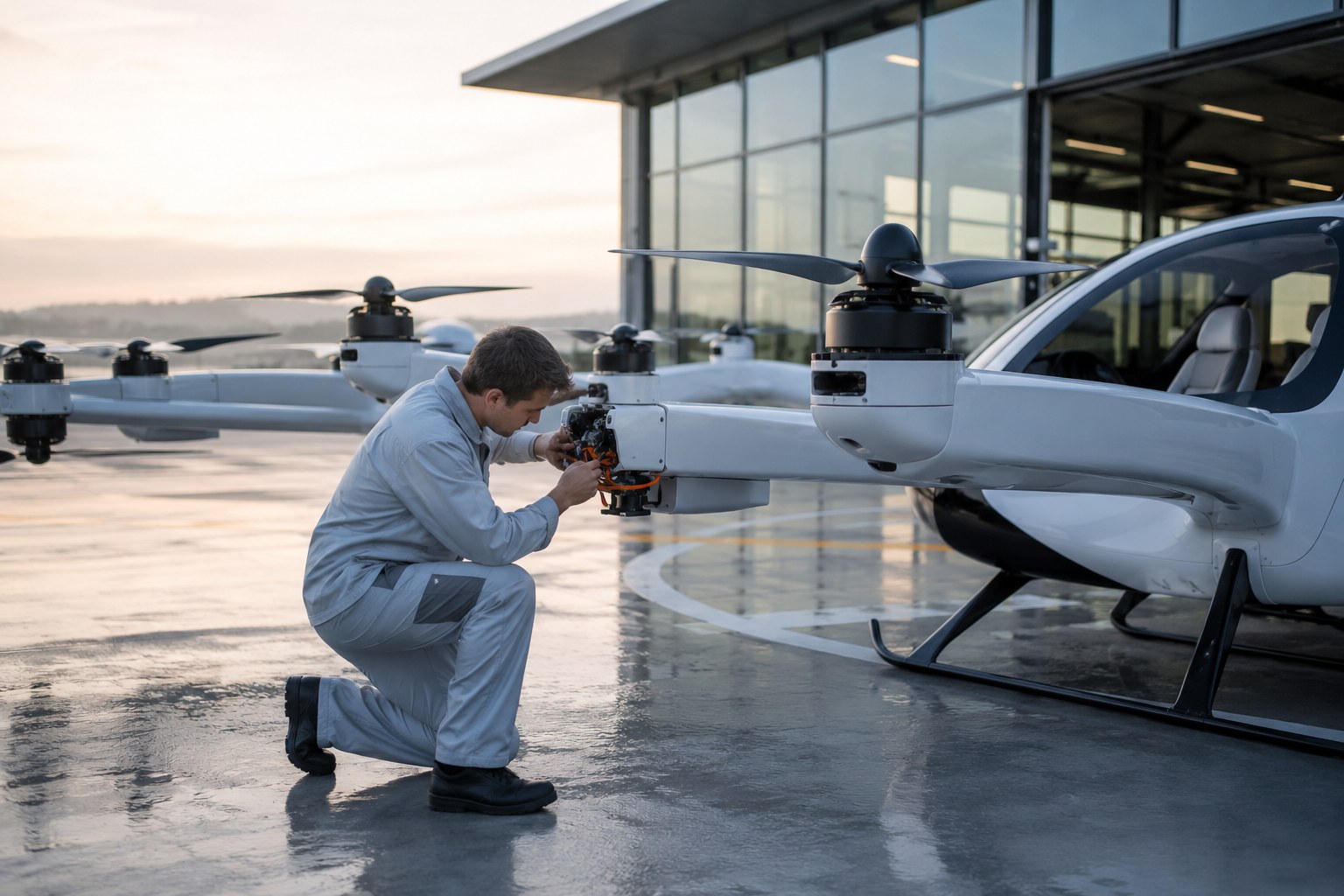
The Advanced Air Mobility (AAM) industry has made remarkable progress in recent years.
Manufacturers around the world are investing billions of dollars to develop electric Vertical Take-Off and Landing (eVTOL) aircraft designed to transform urban transportation, regional mobility, emergency services, cargo operations, and specialized missions. Much of the industry's attention has focused on aircraft development, certification, battery technology, infrastructure, and passenger operations. But once eVTOL aircraft enter commercial service, a new challenge emerges: how will operators maintain these aircraft and keep them flying safely, reliably, and economically? The answer may determine which operators succeed in the long term.
Certification Is Only the Beginning
Receiving type certification is a major milestone, but certification marks the start, not the end, of an aircraft's operational lifecycle.
Once fleets enter service, operators must establish processes for:
- Maintenance planning
- Component tracking
- Spare parts management
- Supplier coordination
- Technical documentation
- Compliance management
- Inventory control
- Reliability monitoring
These activities already represent a significant portion of operating costs for traditional aviation organizations. As eVTOL fleets grow, maintenance and support infrastructure will become equally important.
Will eVTOL Maintenance Be Simpler Than Traditional Aviation?
Many eVTOL manufacturers expect electric propulsion systems to reduce maintenance requirements compared to conventional turbine-powered aircraft.
Electric motors generally contain fewer moving parts and may require less routine maintenance than gas turbine engines. However, eVTOL aircraft introduce new challenges, including:
- High-voltage electrical systems
- Battery health monitoring
- Battery replacement planning
- Advanced flight control systems
- Distributed propulsion architectures
- Specialized software updates
- New inspection requirements
- Cybersecurity considerations
While some maintenance activities may become simpler, others will require entirely new skills, procedures, and support capabilities.
The Rise of eVTOL MRO Services
Just as airlines rely on Maintenance, Repair, and Overhaul (MRO) organizations today, eVTOL operators will likely require specialized support networks.
Future eVTOL MRO providers may offer:
- Line maintenance
- Component repair
- Battery servicing
- Software and avionics support
- Reliability engineering
- Technical records management
- Spare parts logistics
- Fleet health monitoring
As fleets expand across different regions, operators will require maintenance partners capable of supporting aircraft availability and operational readiness.
Spare Parts Will Become a Strategic Asset
One of the most overlooked aspects of Advanced Air Mobility is spare parts management.
Regardless of propulsion technology, aircraft availability depends on parts availability. Operators will need visibility into:
- Replacement components
- Battery inventory
- Repairable units
- Supplier lead times
- Component interchangeability
- Maintenance schedules
- Approved vendor networks
Without effective inventory planning, a single unavailable component could ground an aircraft and disrupt operations. The same supply chain principles that apply to commercial aviation today will increasingly apply to eVTOL operations tomorrow.
Avoiding eVTOL Aircraft on Ground (AOG) Situations
As eVTOL fleets enter service, operators will inevitably face Aircraft on Ground (AOG) events.
Common causes may include:
- Component failures
- Battery issues
- Software-related faults
- Supply chain delays
- Maintenance findings
- Certification or documentation discrepancies
When aircraft are expected to operate high-frequency routes with tight schedules, downtime can quickly affect operational performance, customer experience, and profitability. Organizations that can source parts rapidly, collaborate effectively with suppliers, and maintain visibility across their maintenance ecosystem will be better positioned to minimize downtime.
Avoiding the Legacy Supply Chain Trap
The Advanced Air Mobility industry has a unique opportunity.
Unlike traditional aviation organizations that often rely on decades-old processes and fragmented systems, many eVTOL operators will be building their operational ecosystems from the ground up. Historically, aviation aftermarket supply chains have been challenged by:
- Procurement activities managed through email chains
- Inventory visibility limited to internal systems
- Manual RFQ distribution and quote comparison
- Disconnected supplier communications
- Compliance documentation stored across multiple locations
- Limited visibility into supplier performance
- High administrative workload for procurement and maintenance teams
While these processes evolved over many years, they were not designed for the highly connected and data-driven operations envisioned for Advanced Air Mobility. As eVTOL fleets scale, operators will need to move quickly, manage costs carefully, and maintain exceptional levels of safety and reliability. Replicating legacy supply chain inefficiencies could create unnecessary operational burdens and limit growth. The first generation of eVTOL operators has a unique opportunity to avoid inheriting the inefficiencies of traditional aviation supply chains. Instead, they can adopt modern approaches from day one. Future-ready AAM supply chains will likely be built around:
- Real-time inventory visibility
- Digital supplier collaboration
- Centralized compliance management
- AI-assisted procurement workflows
- Automated RFQ processing
- Data-driven decision-making
- Integrated maintenance and supply chain coordination
Organizations that embrace these capabilities early may achieve lower operational costs, reduced administrative workload, improved fleet availability, and greater scalability as their operations expand.
Why Digital Maintenance Ecosystems Matter
Traditional aviation has learned that disconnected systems create delays.
Emails, spreadsheets, manual records, and fragmented supplier communications often slow decision-making and increase administrative workload. The AAM industry has an opportunity to build modern digital ecosystems from the beginning. Future operators will benefit from:
- Centralized procurement workflows
- Supplier collaboration platforms
- Digital compliance management
- Inventory visibility
- Real-time communication
- Performance analytics
- Predictive maintenance support
Building these capabilities early can help avoid many of the inefficiencies that traditional aviation continues to face.
The Future of eVTOL Maintenance
As the industry matures, maintenance will become a key differentiator.
The most successful operators may not simply be those with the newest aircraft, but those capable of:
- Maintaining high fleet availability
- Managing maintenance efficiently
- Reducing downtime
- Optimizing inventory
- Collaborating effectively with suppliers and maintenance providers
- Scaling operations safely and economically
In aviation, operational readiness ultimately determines commercial success. The same principle will apply to Advanced Air Mobility.
How PartsCollab Supports the Future of AAM
PartsCollab was created to simplify aviation procurement and supply chain collaboration.
As Advanced Air Mobility continues to evolve, many of the same challenges faced by airlines, helicopter operators, suppliers, distributors, and MRO organizations will emerge within the eVTOL ecosystem. Organizations will need to manage suppliers, source components, coordinate maintenance activities, maintain compliance records, manage inventory, and improve visibility across increasingly complex supply chains. By bringing procurement, supplier collaboration, inventory visibility, compliance documentation, and operational workflows into a single aviation-focused workspace, PartsCollab helps organizations build the foundation for scalable and efficient operations. Future technology requires future-ready supply chains. As eVTOL fleets enter service, operators, manufacturers, suppliers, and maintenance organizations will need more efficient, connected, and agile ways to manage procurement, inventory, compliance, and supplier collaboration, without compromising safety, quality, or regulatory requirements. Leveraging technologies such as artificial intelligence, automation, and real-time collaboration platforms will help organizations reduce administrative burden, improve decision-making, and build more resilient supply chain ecosystems. The success of Advanced Air Mobility will depend not only on aircraft innovation, but also on the strength, efficiency, and readiness of the ecosystem that supports it.
Frequently Asked Questions
What is eVTOL maintenance?
eVTOL maintenance refers to the inspection, repair, servicing, monitoring, and support activities required to keep electric Vertical Take-Off and Landing aircraft airworthy and operational.
Will eVTOL aircraft require less maintenance than helicopters?
Many eVTOL manufacturers expect reduced maintenance requirements due to electric propulsion systems. However, battery systems, advanced electronics, software, and distributed propulsion architectures will introduce new maintenance challenges.
What is eVTOL MRO?
eVTOL MRO refers to Maintenance, Repair, and Overhaul services specifically designed to support electric Vertical Take-Off and Landing aircraft throughout their operational lifecycle.
Why is spare parts management important for eVTOL operators?
Aircraft availability depends on parts availability. Effective spare parts management helps operators reduce downtime, avoid AOG situations, improve fleet reliability, and maintain consistent service levels.
What is Advanced Air Mobility (AAM)?
Advanced Air Mobility is an emerging aviation ecosystem that includes eVTOL aircraft, supporting infrastructure, operators, maintenance organizations, suppliers, and technologies designed to enable new forms of air transportation.
How will supply chains evolve for eVTOL operations?
As eVTOL fleets grow, operators will require more connected, data-driven, and collaborative supply chains that provide real-time visibility into inventory, maintenance requirements, supplier performance, compliance documentation, and operational readiness.

