ILSMart and PartsCollab both operate within the digital aviation aftermarket, supporting aircraft parts sourcing and collaboration between buyers and sellers.
The Short Answer
ILS, through the ILSMart marketplace and its wider product portfolio, combines decades of aviation aftermarket experience with extensive marketplace data, repair sourcing, market intelligence and established system connectivity.
PartsCollab is a newer AI-powered aviation marketplace and collaboration platform focused particularly on structuring procurement and sales activity around each transaction. A more useful distinction is this: ILSMart has significant strength in established marketplace data and aftermarket intelligence, while PartsCollab focuses more heavily on operational workflow continuity around procurement and sales cases. This article covers one pairing. The wider field — including PartsBase and Locatory.com — is covered in our aviation parts marketplace comparison.
What Is ILSMart?
ILS traces its history to 1979 and today operates within CAMP Systems, a Hearst company.
ILSMart supports parts and repair-capability discovery, RFQs, seller commerce, auctions, integrations, supplier programs and aviation aftermarket intelligence. Its Market Intelligence portfolio includes tools such as Aviation Data Warehouse, PartStats, Inventory eValuator, Asset Analyzer, Aviation Aftermarket Analyzer and Fair Market Value functionality. Organizations can use this information not only to identify who may have a part, but also to understand historical availability, demand, pricing and other market signals.
What Is PartsCollab?
PartsCollab is an AI-powered aviation marketplace and collaboration platform built around procurement and sales workflows.
Aircraft parts and repair-capability discovery are part of the platform, but its primary differentiation begins when a requirement becomes an active transaction. Quotations, messages, documents, order information, follow-up activity, shipment details, discrepancies and transaction history can remain connected to a structured case. The objective is to help reduce fragmentation across emails, spreadsheets, shared folders, marketplace activity and ERP screens. PartsCollab also incorporates supplier and customer registrations, certification and authorization monitoring, document processing, repair lead-time tracking, warranty workflows and operational analytics. The platform overview sets out how these components connect.
What Is the Main Difference Between ILSMart and PartsCollab?
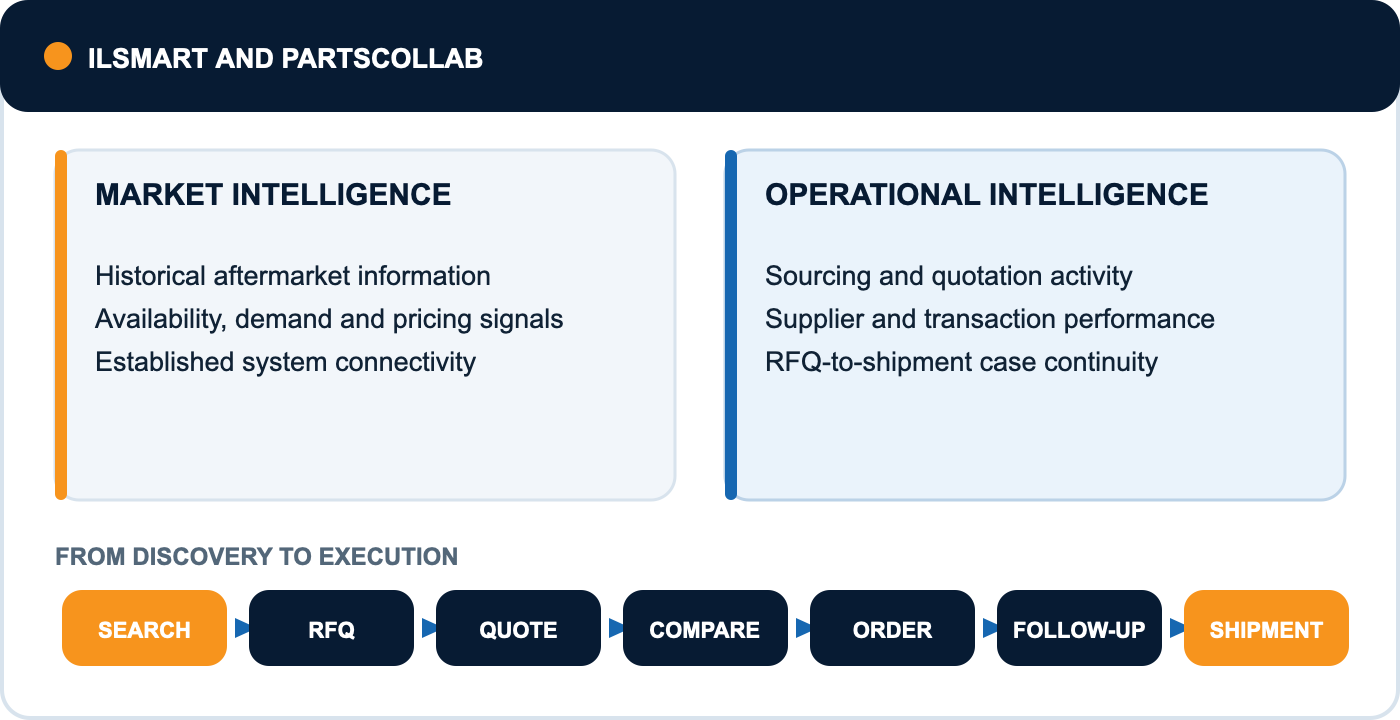
Market Intelligence vs Operational Intelligence
ILS's Market Intelligence portfolio provides aviation organizations with historical and market-level information that can support pricing, availability, demand, inventory and asset decisions.
PartsCollab's intelligence is primarily generated from the organization's own sourcing, quotation, supplier, customer and transaction activity. This can include supplier responsiveness, quotation behavior, business volume, consumption, ordering patterns, delivery activity and case performance. The two approaches answer different questions:
- Market intelligence: What is happening across the aftermarket?
- Operational intelligence: What is happening within our procurement and sales workflow?
Neither replaces the other. An organization that cannot answer the second question tends to discover the cost of that gap indirectly, as we set out in the true cost of manual aviation procurement.
ERP and Supply-Chain Integration
ILS has several publicly documented integration and interoperability capabilities. Connections involving aviation systems such as Quantum Control, CORRIDOR and Pentagon strengthen its position for organizations with established aerospace technology environments.
PartsCollab can begin without requiring an ERP integration. Organizations can upload inventory and capability information directly and begin using marketplace and collaboration workflows — a process we described in how AI processes 25,000 aircraft part numbers. For smaller organizations or pilot implementations, an ERP-independent start may reduce implementation effort. For larger organizations with mature enterprise architecture, named production integrations and clear system-of-record responsibilities may be more important.
AI in ILSMart and PartsCollab
Both platforms use AI-related technology, so the presence of AI alone should not determine a platform choice.
ILS applies AI and machine learning across areas including market intelligence, sourcing, selling and productivity. PartsCollab applies AI assistance across uploaded datasets, quotations, documents, transaction classification, case summaries, discrepancy identification and performance analysis. The more useful question is which tasks AI actually makes faster or easier for your organization. Teams should evaluate AI-supported tools using representative RFQs, quotations and documents and measure extraction accuracy, correction time, user control and traceability.
RFQ and Quotation Workflows
ILSMart provides RFQ and seller-productivity capabilities through its broader marketplace ecosystem. SalesEdge supports seller-side RFQ and quotation activity, while BuyersEdge provides purchasing functionality for buyers.
PartsCollab structures RFQs and quotations as part of a continuing buyer or seller case. Quotations can be normalized and compared while related messages, documents and commercial information remain associated with the requirement. The operational reasoning behind that design is set out in our analysis of aviation RFQ management.
Repair Sourcing and Supplier Trust
ILS has substantial publicly documented functionality around repair sourcing and supplier qualification. Its ecosystem includes the Accredited Vendor Program as well as digital certification and traceability initiatives associated with SmartCert and ProvenAir.
PartsCollab approaches compliance from a workflow-administration perspective. Vendor and customer registration, certification and authorization management, expiry monitoring, renewal reminders, document matching, warranties and audit activity can remain connected with procurement and sales cases. Our review of 172 aviation quarantine cases explains why that connection matters: close to 80% of those cases originated in documentation and data problems rather than defective parts.
RFQ-to-Shipment Collaboration
Supplier selection is not the end of the transaction. Orders require acknowledgements and follow-up, documents arrive, delivery dates change, shipments require monitoring and exceptions can occur.
In PartsCollab, order information, messages, documents, AWB information, shipment events, discrepancies and warranty history can remain connected to the procurement case. For organizations where administrative fragmentation after supplier selection represents a significant workload, this is an area worth evaluating — tracking AWBs across multiple carrier websites alone can consume hundreds of hours a year.
Can ILSMart and PartsCollab Work Together?
ILSMart may remain valuable as an established marketplace and market-intelligence channel while PartsCollab supports selected downstream procurement, sales or collaboration workflows.
Whether this model is efficient depends on how information moves between the systems. Organizations should avoid an architecture that requires users to repeatedly rebuild the same RFQ, quotation or transaction in multiple platforms.
Which Platform May Fit Which Requirement?
ILSMart may be particularly relevant where priorities include established marketplace participation, historical aftermarket intelligence, repair sourcing, supplier programs and proven system connectivity.
PartsCollab may be particularly relevant where priorities include RFQ-to-shipment case continuity, quotation comparison, external supplier collaboration, registration workflows, document processing and operational transaction management. The appropriate choice depends on the organization's existing technology environment and where the largest procurement or sales bottleneck exists. Our aviation parts sourcing platform checklist covers the questions worth putting to any vendor, and the same comparison applied to other marketplaces is available in PartsCollab vs PartsBase and PartsCollab vs Locatory.com.
Frequently Asked Questions
Is ILSMart only an aircraft parts search marketplace?
No. ILS provides sourcing, selling, repair, integration, supplier and market-intelligence products in addition to aircraft parts discovery.
Which platform has more established aviation market intelligence?
ILS has the more extensive publicly documented historical aftermarket-intelligence portfolio. PartsCollab's analytics focus more heavily on information generated from an organization's own procurement and sales activity.
Which platform has stronger publicly documented ERP integration?
ILS has several named and publicly documented connections within the aviation software ecosystem. PartsCollab offers custom integration but is newer and has fewer publicly documented production references.
Is PartsCollab an alternative to ILSMart?
It can be evaluated as an alternative for certain workflows, but the products are not identical. Organizations primarily seeking established marketplace scale and aftermarket intelligence may evaluate ILS differently from organizations seeking structured RFQ-to-shipment collaboration.
Can organizations use both?
Yes. Aviation organizations commonly use multiple sourcing and enterprise systems. The important consideration is whether each platform has a clear role and whether information can move between them efficiently.
Comparison Methodology
This article is intended for general informational purposes and is based on publicly available information from the platforms referenced as of September 2026. Features, integrations, terminology and commercial offerings may change over time or vary by subscription and implementation.
PartsCollab does not claim that capabilities not described here are unavailable. Organizations should confirm current functionality and commercial terms directly with each provider. Official sources consulted: ILS/ILSMart product information, ILS Market Intelligence information, publicly available ILS integration and traceability information, and PartsCollab product information. ILS and ILSMart are trademarks of their respective owners. This comparison is based on publicly available information and is not affiliated with or endorsed by ILS or CAMP Systems.

