PartsBase and PartsCollab both help aviation organizations connect buyers and sellers, search for aircraft parts and manage sourcing activity. However, the two platforms have developed from different starting points.
The Short Answer
PartsBase is an established aviation marketplace with decades of industry presence, a mature buyer and seller network, and an ecosystem covering parts search, supplier discovery, purchasing and related aviation services.
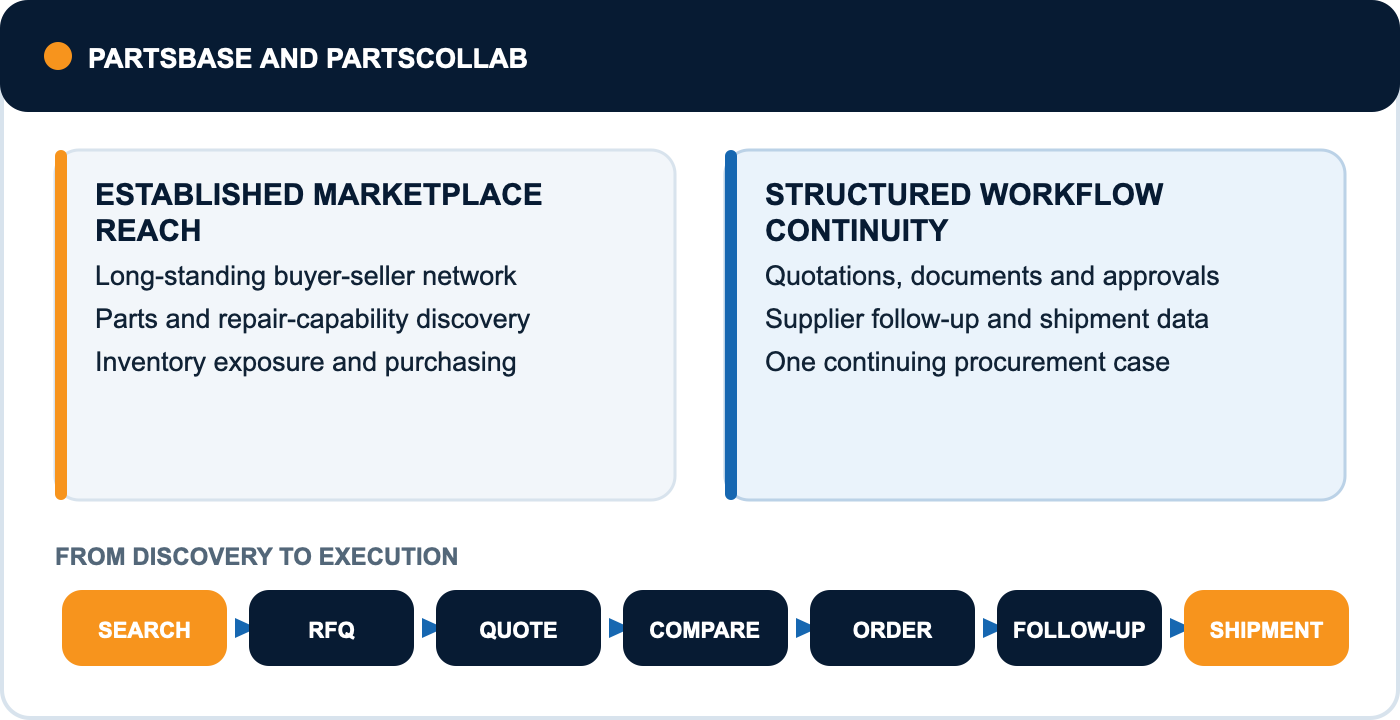
PartsCollab is a newer AI-powered aviation marketplace and collaboration platform with a particular focus on the operational workflow surrounding procurement and sales transactions. A more useful question is whether your organization primarily needs established marketplace reach or greater structure from RFQ through shipment. This article looks at one pairing in detail. If you are evaluating the wider field, our pillar comparison of PartsBase, ILSMart, Locatory.com and PartsCollab covers all four platforms side by side.
What Is PartsBase?
PartsBase has operated in the aviation aftermarket since 1996 and has developed into one of the industry's established digital sourcing environments.
Its ecosystem includes PBLocator for parts and repair-capability search, PartStore for purchasing, AeroPages for supplier and MRO discovery, aircraft and engine listing services, government-data services and other marketplace tools. PartsBase also operates PBExpo, bringing together companies from across the aviation aftermarket. Its long market history is important. Aviation marketplaces depend heavily on network participation: buyers benefit when relevant suppliers and inventory are present, while sellers benefit when active buyers generate qualified demand. For organizations primarily seeking broad aviation parts discovery, inventory exposure and access to an established sourcing network, that marketplace maturity can be a significant consideration.
What Is PartsCollab?
PartsCollab is an AI-powered aviation marketplace and collaboration platform designed to connect aircraft parts and repair-capability discovery with the operational workflow that follows.
Its broader focus is on maintaining continuity as a requirement progresses through: Search → RFQ → Quotation → Comparison → Order → Follow-Up → Shipment Messages, quotations, commercial terms, documents, shipment information, discrepancies and transaction history can remain connected to the same procurement or sales case. PartsCollab also incorporates workflows around vendor and customer registration, certification and authorization monitoring, expiration reminders, warranty management, repair lead-time tracking, document processing and transaction analysis. The PartsCollab platform overview sets out how these pieces fit together. The objective is not to replace the organization's ERP. It is to provide a structured collaboration layer around the activities that often take place between buyers, sellers, MROs, email inboxes and enterprise systems.
What Is the Main Difference Between PartsBase and PartsCollab?
Aircraft Parts and Repair Capability Discovery
PartsBase provides established parts and repair-capability discovery through its marketplace ecosystem. PartsCollab also allows buyers to search inventory and repair capabilities and connect those results directly with sourcing and case-management workflows.
Marketplace size alone, however, should not be the only measure of sourcing effectiveness. When evaluating either platform, aviation buyers may want to consider:
- relevant active suppliers for their aircraft and component categories;
- how recently inventory has been updated;
- supplier response rates;
- geographical coverage;
- repair-capability coverage; and
- how easily search results can be converted into actionable quotations.
These measures can be more useful than headline inventory totals alone. The second point in particular deserves testing before a subscription decision, which is why we wrote separately about why data freshness matters in aircraft parts sourcing.
Inventory Upload and ERP Connectivity
PartsBase supports established inventory-distribution practices and has publicly documented connectivity with aviation ERP environments, including Quantum Control. This can be valuable for organizations that already maintain structured inventory within established aerospace systems.
PartsCollab supports direct inventory and capability uploads without requiring an ERP integration as the first step. Its AI-assisted dataset processing is designed to help structure uploaded inventory and capability information, while freshness indicators help users understand how recently datasets have been updated. We documented what that looks like at volume in how AI processes 25,000 aircraft part numbers. This ERP-independent starting point can reduce onboarding friction for organizations that want to begin sourcing or selling before implementing a deeper system integration. Larger organizations should evaluate both approaches based on their system architecture, data ownership and synchronization requirements.
RFQs and Quotation Comparison
PartsBase connects parts discovery with RFQ and purchasing activity through its wider ecosystem.
PartsCollab structures the RFQ as the beginning of a continuing procurement or sales case. Supplier quotations can be collected and compared while supporting communication, documents and commercial information remain associated with the requirement. AI-assisted processing can also support quotation structuring and comparison. The operational case for this is set out in our analysis of aviation RFQ management. The objective is not to automate the commercial decision itself. Buyers remain responsible for evaluating condition, price, lead time, certification, warranty, exchange requirements and other commercial or technical factors.
What Happens After the RFQ?
Once a supplier is selected, the procurement process may still involve purchase orders, acknowledgements, promised delivery dates, invoices, packing lists, certificates, AWB information, shipment updates and discrepancies.
PartsBase provides transactional purchasing functionality through PartStore and its broader marketplace ecosystem. PartsCollab's design places particular emphasis on keeping these later events connected to the procurement case. For organizations that currently manage post-RFQ activity across email, spreadsheets, shared folders and ERP screens, this workflow continuity may be useful. When we mapped a single complex line item minute by minute, nearly 40 minutes of every hour went to managing information rather than making procurement decisions, and tracking AWBs across multiple carrier websites accounted for a measurable share of it.
Compliance and Supplier Administration
Supplier registrations, certifications, authorizations, expiry dates and supporting documentation can affect whether a transaction can proceed.
PartsBase supports certificates and transaction documentation within its marketplace and purchasing environment. PartsCollab organizes vendor and customer registration, certification and authorization records, expiration monitoring, renewal reminders, document matching, discrepancies, warranties and audit history closer to the procurement and sales case. The question is how compliance information connects with the organization's sourcing and transaction workflow. Our review of 172 aviation quarantine cases found that close to 80% originated in documentation and data problems rather than defective parts, which is largely a workflow issue rather than a marketplace one.
AI in Aviation Procurement
PartsCollab applies AI-assisted processing across areas including uploaded datasets, quotations, documents, case classification, summaries, discrepancy identification and performance analysis.
The value of these tools should be measured by their operational results rather than by the AI label itself. Aviation organizations evaluating AI-supported procurement tools should consider extraction accuracy, correction effort, user control, traceability and measurable time savings — the same variables that drive the true cost of manual aviation procurement. Commercial, quality and airworthiness decisions should remain reviewable by accountable professionals.
Can PartsCollab Replace PartsBase?
Not necessarily — and replacement does not need to be the objective.
An organization that values PartsBase for marketplace reach and supplier discovery may continue using that sourcing channel while using PartsCollab for selected procurement, sales, compliance or downstream transaction workflows. The appropriate model depends on supplier participation, existing systems, procurement volume and the organization's operational priorities.
PartsBase or PartsCollab: How Should Organizations Evaluate the Choice?
PartsBase may be relevant when priorities include established marketplace reach, inventory exposure, supplier discovery and access to the broader PartsBase ecosystem.
PartsCollab may be relevant when priorities include structured quotation comparison, procurement and sales collaboration, compliance administration, document control and RFQ-to-shipment case continuity. Rather than selecting a platform based on the longest feature list, organizations can evaluate both marketplace reach and workflow depth independently. Our aviation parts sourcing platform checklist sets out the questions worth asking any vendor before subscribing. If PartsBase is not the only platform on your shortlist, the same analysis applied to the other established marketplaces is available in PartsCollab vs ILSMart and PartsCollab vs Locatory.com. If you would rather test the workflow side against your own RFQs, you can book a PartsCollab demo.
Frequently Asked Questions
Is PartsBase only an aircraft parts search database?
No. PartsBase's ecosystem extends beyond parts search and includes supplier and MRO discovery, RFQs, transactional purchasing through PartStore and other aviation marketplace services.
What is the main difference between PartsBase and PartsCollab?
PartsBase brings a long-established marketplace network and sourcing ecosystem. PartsCollab is newer and focuses particularly on structured procurement, sales, compliance and RFQ-to-shipment collaboration.
Does PartsCollab have a larger marketplace than PartsBase?
Publicly available information does not support that conclusion. PartsBase has the more established marketplace network. PartsCollab's differentiation is centered on workflow and transaction collaboration rather than claiming greater historical marketplace scale.
Does PartsCollab replace an aviation ERP?
No. PartsCollab is positioned as a marketplace and collaboration layer rather than a replacement for a full aviation ERP, maintenance or finance system.
Can PartsBase and PartsCollab be used together?
Yes. Different platforms can serve different roles within an aviation organization's sourcing and procurement architecture, provided that the resulting workflow does not create unnecessary duplicate work.
Comparison Methodology
This article is intended for general informational purposes and is based on publicly available information from the platforms referenced as of September 2026. Features, integrations, terminology and commercial offerings may change over time or vary by subscription and implementation.
PartsCollab does not claim that capabilities not described here are unavailable. Organizations should confirm current functionality and commercial terms directly with each provider. Official sources consulted: PartsBase official product information, PartsBase aviation marketplace materials, publicly available integration information and PartsCollab product information. PartsBase is a trademark of its respective owner. This comparison is based on publicly available information and is not affiliated with or endorsed by PartsBase.

