Choosing an aviation parts marketplace is no longer simply about determining which platform contains the most aircraft parts listings.
Two Dimensions, Not One
PartsBase, ILSMart, Locatory.com and PartsCollab all connect aviation buyers and sellers, but they have developed around different strengths.
PartsBase and ILS have decades of aviation marketplace experience and established networks. Locatory.com has developed an international marketplace supported by sourcing, supplier, analytics, logistics and integration services. PartsCollab is a newer AI-powered aviation marketplace and collaboration platform focused particularly on structured procurement, sales, compliance and RFQ-to-shipment workflows. Which aviation marketplace is right for your organization depends on its sourcing strategy, supplier network, ERP environment and operational priorities. A useful comparison needs to consider at least two dimensions:
- Marketplace reach: supplier participation, inventory visibility, repair capabilities, market data and integrations.
- Workflow depth: what happens after a potential source is identified — from quotations and approvals through orders, documents, shipments and exceptions.
Aviation Marketplace Comparison at a Glance
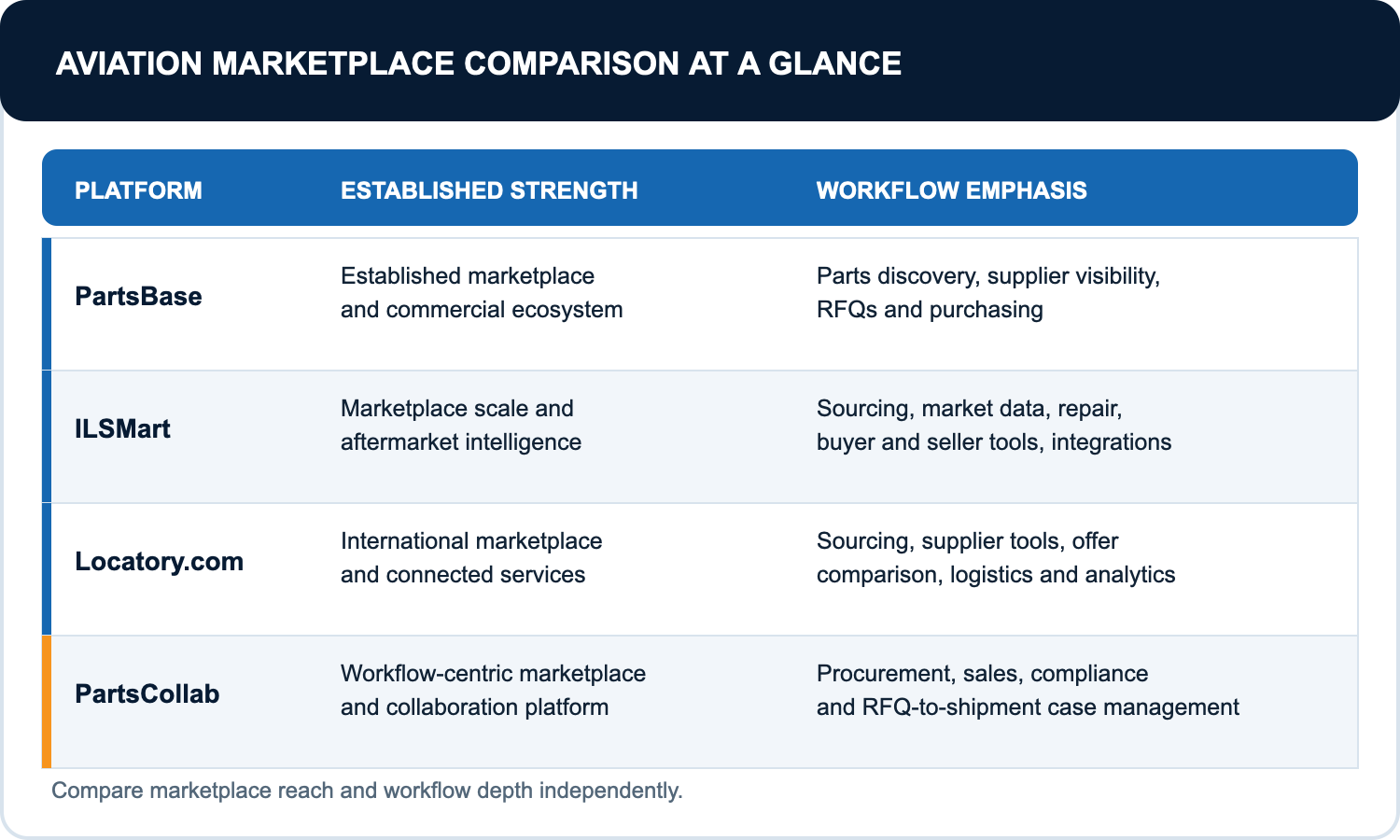
| Platform | Established strength | Workflow emphasis |
|---|---|---|
| PartsBase | Established marketplace and commercial ecosystem | Parts discovery, supplier visibility, RFQs and purchasing |
| ILSMart | Marketplace scale and aftermarket intelligence | Sourcing, market data, repair, buyer and seller tools, integrations |
| Locatory.com | International marketplace and connected services | Sourcing, supplier tools, offer comparison, logistics and analytics |
| PartsCollab | Workflow-centric marketplace and collaboration platform | Procurement, sales, compliance and RFQ-to-shipment case management |
| Compare marketplace reach and workflow depth independently. Compiled from publicly available information as of September 2026. | ||
| Each pairing is examined in more depth in PartsCollab vs PartsBase, PartsCollab vs ILSMart and PartsCollab vs Locatory.com. |
How Aviation Parts Marketplaces Have Evolved
The first generation of digital aviation marketplaces solved an important industry problem: how can buyers find aircraft parts and repair capabilities beyond their existing supplier network?
Established aviation marketplaces have spent years building relationships between airlines, MROs, distributors, OEMs, stockists, repair organizations and other aviation businesses. But another challenge becomes visible once the supplier is found. Quotations arrive in different formats, commercial terms must be compared, certificates and supplier approvals may require review, and orders and delivery dates require follow-up. Invoices, packing lists and AWBs appear later; shipments move, and discrepancies or warranty cases may reopen the transaction after delivery. Modern aviation procurement technology therefore increasingly addresses not only discovery, but also execution — the same shift we described in aviation supply chain digitalization.
PartsBase: Established Aviation Marketplace Reach
PartsBase has operated in the aviation aftermarket since 1996 and has developed a broad commercial ecosystem.
Its products include PBLocator for parts and repair-capability search, PartStore for purchasing, AeroPages for supplier and MRO discovery and additional aircraft, engine and government-data services. PartsBase also operates PBExpo, reinforcing its connection with the wider aviation aftermarket community. For buyers, that can mean access to a long-developed sourcing channel; for sellers, visibility to an established aviation audience. PartsBase also extends beyond simple search through purchasing, mobile and integration functionality. Organizations evaluating PartsBase should therefore consider both its marketplace reach and how its broader ecosystem fits their sourcing process. Our detailed pairing is in PartsCollab vs PartsBase.
ILSMart: Marketplace Data and Aviation Market Intelligence
ILS has an even longer history, dating to 1979, and today operates within CAMP Systems. Its ILSMart marketplace supports aircraft parts and repair sourcing, RFQs, selling, auctions and other aftermarket activities.
One of ILS's most clearly documented differentiators is its market-intelligence portfolio. Products including Aviation Data Warehouse, PartStats, Inventory eValuator, Asset Analyzer, Aviation Aftermarket Analyzer and Fair Market Value functionality provide access to historical aftermarket information. This can help organizations examine availability, demand, pricing and other market signals in addition to identifying suppliers. ILS also has publicly documented connectivity with established aviation and enterprise technology environments. For organizations where marketplace scale, aftermarket data and system integration are major priorities, these capabilities can be important considerations. See PartsCollab vs ILSMart for the detailed pairing.
Locatory.com: Marketplace Plus Connected Services
Locatory.com was founded in 2010 and has developed into an international aviation marketplace.
Its services include aircraft parts and repair-capability search, RFQs, offer comparison, supplier tools, price-history functionality, demand analytics, public inventory catalogs, surplus services, shipping and AOG-related support. Locatory has also developed integrations with other aviation technology platforms, and its Amber A.I. functionality applies automation to incoming RFQ requirements and supplier matching. This gives Locatory a broad marketplace proposition combining sourcing with adjacent supplier and logistics services. For organizations seeking an international aviation marketplace with these connected services, Locatory represents an established option — examined further in PartsCollab vs Locatory.com.
PartsCollab: The Transaction as a Continuing Case
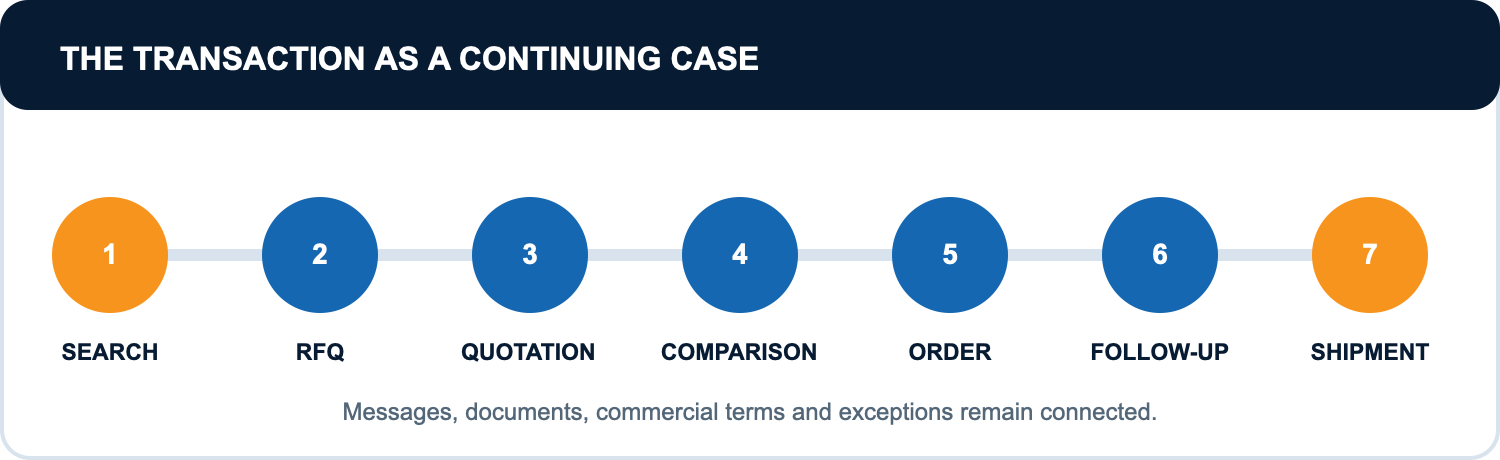
PartsCollab is designed around the idea that finding a supplier is only the beginning of the procurement process. A requirement can progress through search, RFQ, quotation, comparison, order, follow-up and shipment as one continuing case.
 PartsCollab also brings vendor and customer registration, certification and authorization monitoring, expiration reminders, document processing, repair lead-time tracking, warranties, discrepancies and operational analytics closer to procurement and sales activity.
The platform is positioned as a collaboration and workflow layer rather than as a replacement for a full ERP or maintenance system. The reasoning behind that decision is set out in why we created PartsCollab.
PartsCollab also brings vendor and customer registration, certification and authorization monitoring, expiration reminders, document processing, repair lead-time tracking, warranties, discrepancies and operational analytics closer to procurement and sales activity.
The platform is positioned as a collaboration and workflow layer rather than as a replacement for a full ERP or maintenance system. The reasoning behind that decision is set out in why we created PartsCollab.
Marketplace Reach vs Workflow Depth
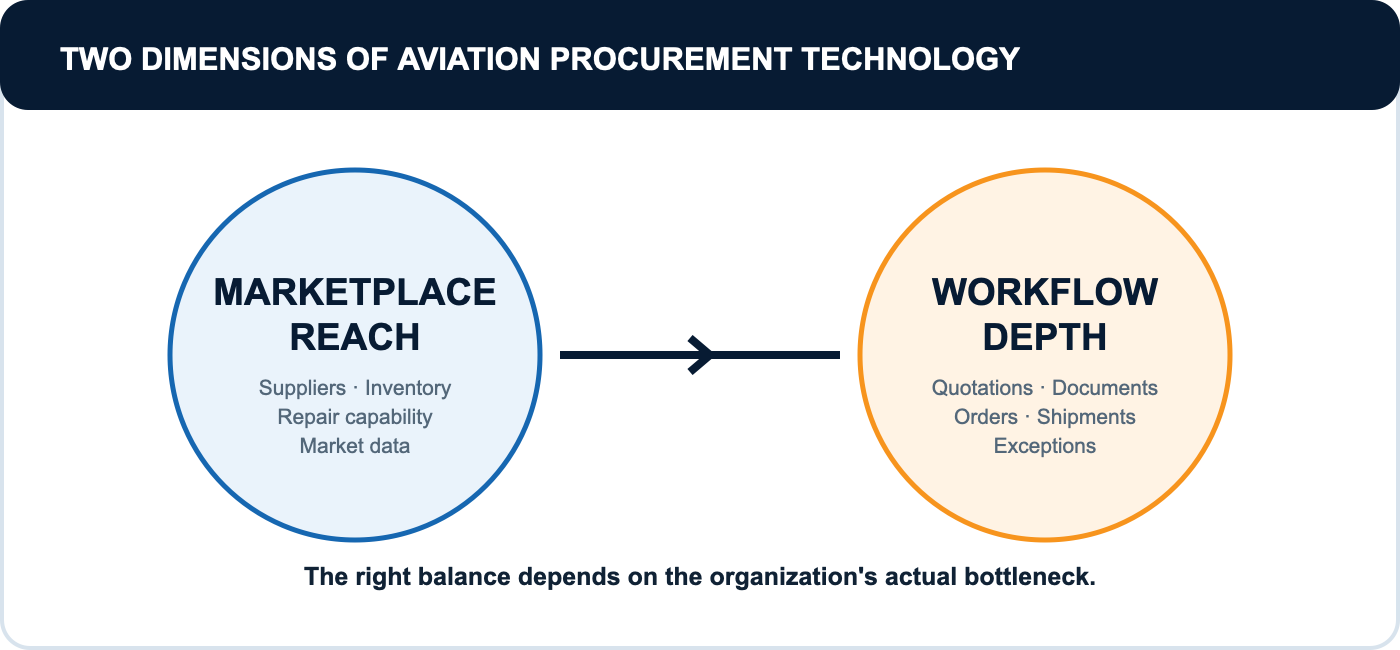 PartsBase, ILSMart and Locatory have had considerably more time to develop marketplace networks. Buyers benefit from relevant inventory and supplier participation, while suppliers benefit from active buyers and qualified demand.
PartsCollab is earlier in this network-development cycle. Instead, it places greater emphasis on the operational work surrounding each transaction — work that is easy to underestimate until it is measured. When we mapped a single complex line item minute by minute, nearly 40 minutes of every hour went to managing information rather than making procurement decisions.
A large marketplace is not automatically the best workflow system, just as a sophisticated workflow system is not automatically the marketplace with the broadest supplier coverage. The relevant question is which problem matters most to the organization — or whether both need to be addressed.
PartsBase, ILSMart and Locatory have had considerably more time to develop marketplace networks. Buyers benefit from relevant inventory and supplier participation, while suppliers benefit from active buyers and qualified demand.
PartsCollab is earlier in this network-development cycle. Instead, it places greater emphasis on the operational work surrounding each transaction — work that is easy to underestimate until it is measured. When we mapped a single complex line item minute by minute, nearly 40 minutes of every hour went to managing information rather than making procurement decisions.
A large marketplace is not automatically the best workflow system, just as a sophisticated workflow system is not automatically the marketplace with the broadest supplier coverage. The relevant question is which problem matters most to the organization — or whether both need to be addressed.
RFQs and Quotation Comparison
All four platforms participate in RFQ activity in different ways.
- PartsBase connects sourcing and RFQs with its wider marketplace and purchasing ecosystem.
- ILSMart combines marketplace sourcing with buyer and seller productivity tools.
- Locatory supports RFQs, offer comparison and automated processing of incoming requirements.
- PartsCollab treats the RFQ as the beginning of a continuing procurement or sales case.
Feature lists alone will not separate them. Organizations should instead examine what happens when multiple suppliers respond with different conditions, currencies, lead times, certifications, exchange requirements, warranties and commercial terms. That is where manual RFQ workflows create both effort and risk. The best system is the one that makes this real work more manageable for the organization's users.
Market Intelligence vs Operational Intelligence
ILSMart has a particularly extensive publicly documented aviation aftermarket-intelligence portfolio. PartsBase also provides market information and aviation data services, and Locatory provides price-history and demand-analysis functionality.
PartsCollab focuses more heavily on intelligence generated from the organization's own operational activity. This may include supplier responsiveness, quotation history, customer activity, business volume, consumption, ordering behavior, delivery performance and discrepancies. Market intelligence asks what is happening across the aviation aftermarket; operational intelligence asks what is happening across the organization's own procurement and sales process. Organizations that cannot answer the second question usually pay for it indirectly, as set out in the true cost of manual aviation procurement.
AI Across Aviation Marketplaces
ILS applies AI and machine learning within areas including market intelligence, sourcing and seller productivity. Locatory has used Amber A.I. for RFQ-related automation. PartsCollab applies AI assistance across uploaded datasets, quotations, documents, transaction classification, case summaries, discrepancies and performance analysis.
The useful question is which tasks AI makes measurably easier, faster or more accurate. Organizations should test AI functionality with their own RFQs, quotations and documents and maintain appropriate human review for commercial, quality and airworthiness decisions. Our walkthrough of how AI processes 25,000 aircraft part numbers is one example of the kind of evidence worth asking any vendor to produce.
Compliance, Certificates and Supplier Qualification
An available aircraft part is not automatically a commercially or technically acceptable part.
ILS has publicly documented supplier-accreditation and digital traceability initiatives. PartsBase supports certificates and documentation around marketplace and purchasing activity. Locatory provides supplier-management functionality within its ecosystem. PartsCollab organizes vendor and customer registration, certifications, authorizations, expiration monitoring, renewal reminders, document matching, warranties, discrepancies and audit activity alongside procurement and sales cases. The comparison should therefore focus on how each organization's required controls fit into the workflow, rather than claiming that compliance exists only on one platform. Our review of 172 aviation quarantine cases found that close to 80% originated in documentation and data problems rather than defective parts.
From Purchase Order to Shipment
Orders need acknowledgement, promised dates may change, documents must be collected, invoices and packing lists need checking, and AWBs are issued. Shipments require monitoring, and exceptions need resolution.
PartsBase provides purchasing functionality through PartStore. ILSMart provides commerce and purchasing functionality within its ecosystem. Locatory provides shipping and AOG-related services. PartsCollab emphasizes maintaining order, document, communication, shipment and exception information within the continuing procurement case. Organizations should evaluate how much context remains connected after the sourcing decision and how easily users can understand the complete transaction history. The cost of losing that context is measurable: tracking AWBs across multiple carrier websites alone can consume hundreds of hours a year, and during an AOG event every hour carries a direct operational cost.
ERP Integration and ERP-Independent Workflows
ILS has several publicly documented integrations with established aviation software environments. PartsBase also has documented integration paths, including Quantum Control connectivity. Locatory has publicly documented integrations including AvSight and Rotabull. PartsCollab supports direct dataset onboarding and can begin without an ERP integration, while custom integration can be considered depending on enterprise requirements.
An ERP-independent start can make pilots and onboarding easier. An established enterprise may instead prioritize production integrations, synchronization and clear system-of-record ownership. The right architecture depends on the organization's technology environment.
Which Aviation Marketplace Fits Which Organization?
- PartsBase may be relevant when established aviation marketplace reach, supplier visibility, inventory exposure and the broader PartsBase commercial ecosystem are important.
- ILSMart may be relevant when marketplace scale, historical aftermarket intelligence, repair sourcing, supplier programs and established integration capabilities are priorities.
- Locatory.com may be relevant when international marketplace access, sourcing tools, supplier services, public catalog functionality, logistics services and marketplace integrations fit the operating model.
- PartsCollab may be relevant when the organization wants greater structure around quotations, supplier collaboration, compliance administration, documents, order follow-up, shipments and exceptions within an RFQ-to-shipment case.
Do Aviation Organizations Need Only One Marketplace?
Airlines, MROs, operators, distributors and suppliers commonly use multiple sourcing channels. These may include approved supplier networks, OEM relationships, aviation marketplaces, ERP systems, direct emails and other digital tools.
A mature procurement architecture may therefore combine marketplace discovery with internal systems and external collaboration platforms. Using multiple platforms can expand market access, but too many disconnected platforms can also create duplicate work. The objective should be greater connectivity without greater fragmentation.
How Should Organizations Compare Aviation Marketplaces?
Rather than relying only on a feature matrix, organizations can evaluate platforms using representative sourcing scenarios. Useful questions include:
- Are relevant suppliers and repair capabilities active for our aircraft and component categories?
- How recently has the relevant inventory been updated?
- How efficiently can multiple quotations be compared?
- How are certificates and supporting documents connected to the transaction?
- What happens after an RFQ becomes a purchase or repair order?
- How are shipment events and exceptions managed?
- Which ERP and enterprise integrations are currently supported?
- What information can be exported if the organization changes systems?
- Which tasks are actually improved by AI or automation?
The second question is worth testing rather than assuming — stale listings are one of the most common sources of wasted RFQ rounds, as we set out in why data freshness matters in aircraft parts sourcing. Our aviation parts sourcing platform checklist expands the full list into a vendor evaluation you can run in a single meeting.
The Aviation Marketplace Is Evolving
Digital aviation marketplaces made global aircraft parts and repair capabilities easier to discover. The established platforms that built these networks helped create much of the connectivity the aviation aftermarket relies on today.
The next stage of digital aviation procurement is increasingly about connecting discovery with execution: finding the supplier, collecting the quotation, comparing the options, controlling documentation, following the order, tracking the shipment, managing exceptions and learning from the transaction. For aviation organizations, the opportunity is not simply to find the marketplace with the most features. It is to build a sourcing and procurement environment that combines market access, reliable information and efficient execution. If you want to test that second half against your own RFQs, you can see the PartsCollab platform or book a demo.
Frequently Asked Questions
Which aviation marketplace has the largest network?
Public marketplace figures vary by provider, year and definition. PartsBase and ILS are long-established aviation marketplaces, Locatory has an established international network, and PartsCollab is a newer entrant. Organizations should evaluate active coverage within their own aircraft, component and geographical requirements rather than relying only on headline listing totals.
Which platform has the strongest aviation market-intelligence offering?
ILS has the most extensive publicly documented aftermarket-intelligence portfolio among the four platforms reviewed here. PartsBase and Locatory also provide market-data and analytics functionality, while PartsCollab focuses more heavily on operational intelligence generated from an organization's own procurement and sales cases.
Which platform is best for aviation procurement?
There is no universal best platform. The appropriate choice depends on whether the organization's priorities are marketplace reach, market intelligence, supplier exposure, integrations, workflow management, compliance, logistics or a combination of these requirements.
Is PartsCollab an alternative to PartsBase, ILSMart or Locatory?
PartsCollab can be evaluated as an alternative for some workflows and as a complementary platform for others. Its primary differentiation is structured procurement, sales, compliance and RFQ-to-shipment collaboration rather than historical marketplace scale.
Does PartsCollab replace an ERP?
No. PartsCollab is positioned as an aviation marketplace and collaboration layer. Organizations should continue to define which system owns inventory, purchasing, finance, maintenance records and other enterprise data.
Is AI a meaningful difference between aviation marketplaces?
AI can be useful, but the label alone is not a meaningful differentiator. Organizations should evaluate which tasks are automated, how accurate the results are, how corrections are handled and whether accountable users retain control over important decisions.
Can an organization use more than one aviation marketplace?
Yes. Many aviation organizations use multiple sourcing channels. The key consideration is whether the combination increases useful market coverage without creating unnecessary duplicate data entry or fragmented transaction records.
Comparison Methodology
This article is intended for general informational purposes and is based on publicly available information from the platforms referenced as of September 2026. Features, integrations, terminology and commercial offerings may change over time or vary by subscription and implementation.
PartsCollab does not claim that capabilities not described here are unavailable. References to third-party companies and products are provided solely for identification and comparison. Organizations should confirm current functionality, integrations and commercial terms directly with each provider. Official sources consulted: PartsBase official product information, ILS/ILSMart official marketplace and Market Intelligence information, Locatory.com official marketplace and product information, publicly available integration information, and PartsCollab product information. PartsBase, ILS, ILSMart and Locatory.com are trademarks of their respective owners. This comparison is based on publicly available information and is not affiliated with or endorsed by any of them.

