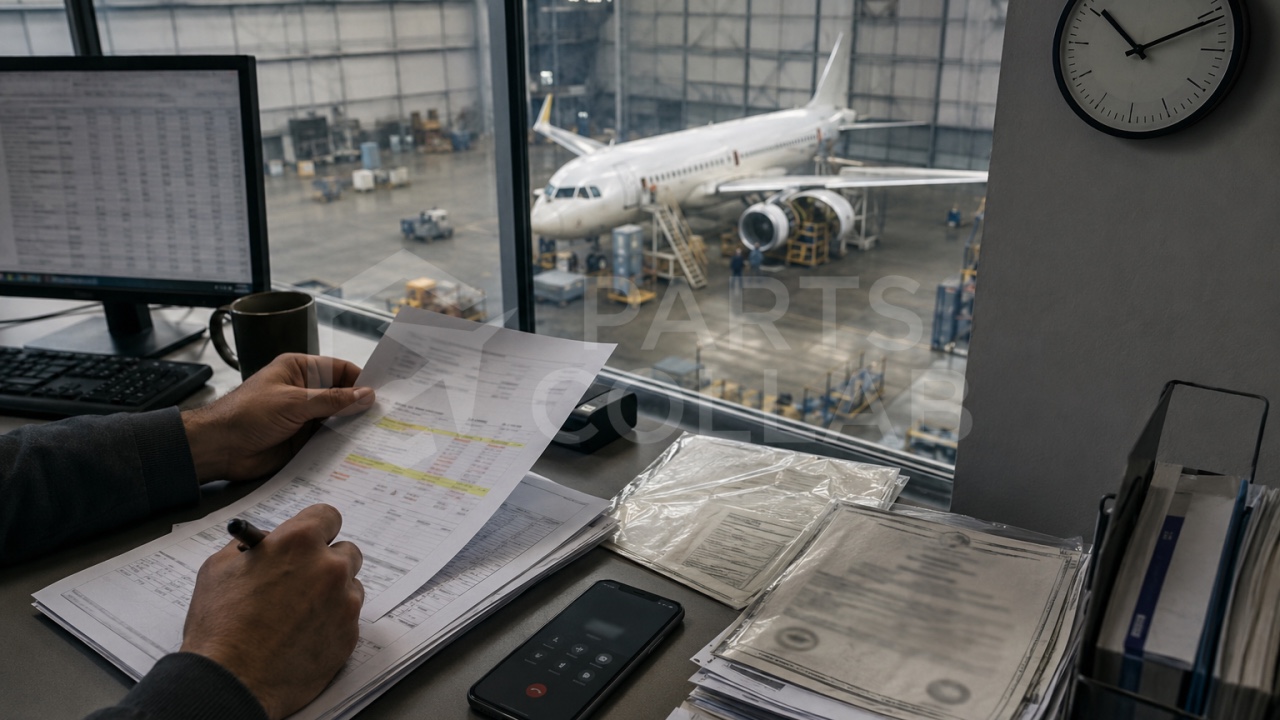
A minute-by-minute breakdown of a single complex purchase request, and why most of the hour is administrative work rather than procurement judgement.
The Question Behind This Analysis
A few months ago we published an analysis of 172 real aviation quarantine cases. The conclusion was uncomfortable: nearly 80% of those cases originated before the shipment ever left the supplier. Most of those discrepancies could have been prevented through better validation at the source, avoiding the delay, the administrative effort, the operational disruption, and the cost that followed.
How Much Time Does a Procurement Officer Actually Spend on One Part?
To answer that, we mapped the end-to-end workflow for a typical complex aviation spare part purchase, from the first inventory check to the moment the discrepancy queue is finally clear.
The Finding: Around 60 Minutes per Complex Line Item
An experienced procurement officer spends approximately 60 minutes processing a single complex purchase request, and handles around 8 complex line items during a typical working day.
- 60 minutes per complex purchase request
- Around 8 complex line items per working day
- Nearly 40 minutes of each hour spent managing information rather than making procurement decisions
Before we mapped it, we assumed most of that hour would go to the things procurement teams are actually hired to do: identifying the right suppliers, evaluating quotations, and negotiating commercial terms. It did not. Nearly two-thirds of the procurement cycle is spent moving information from one place to another.
Where the Hour Actually Goes
The mapped workflow breaks down as follows.
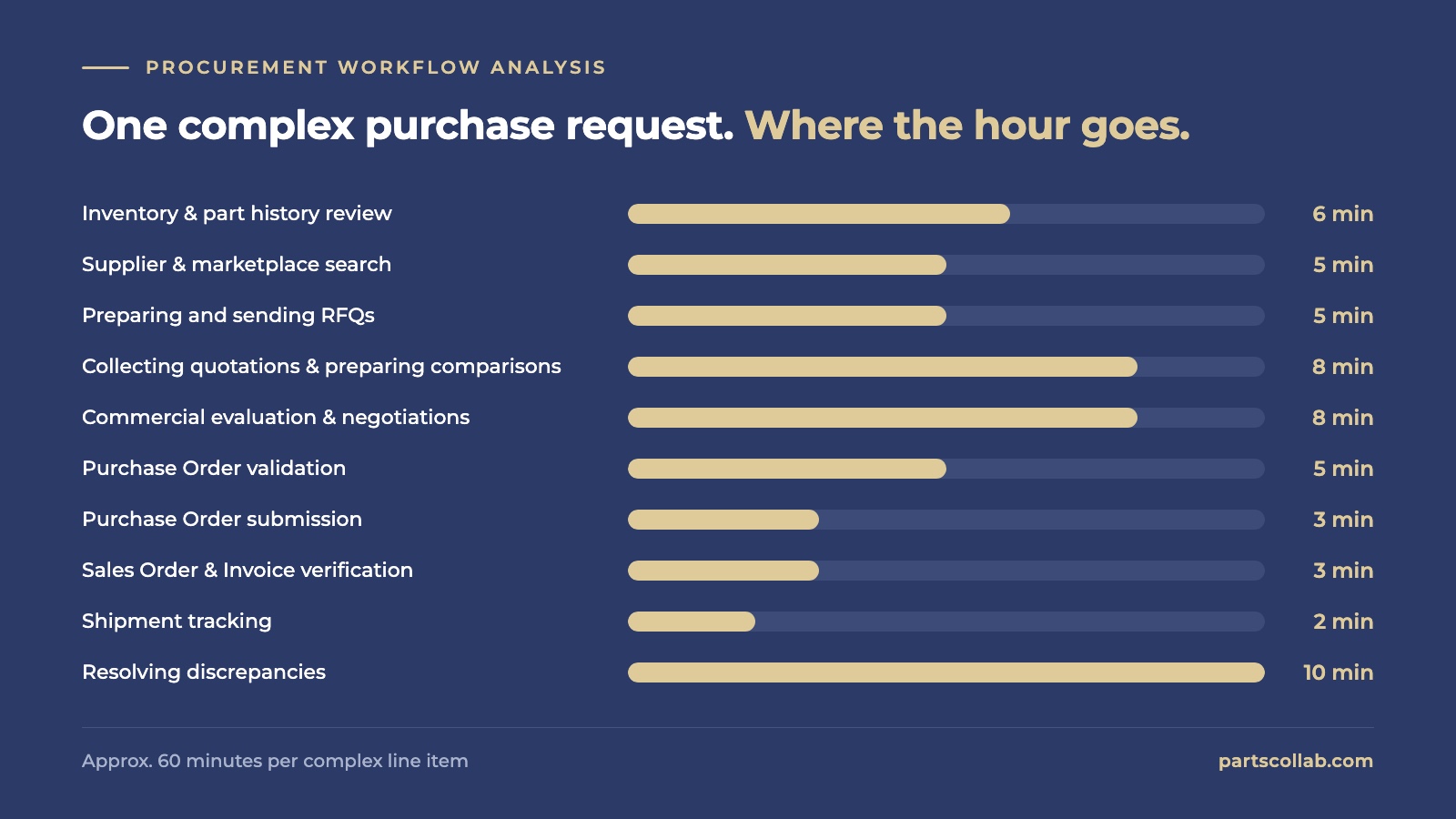
- Inventory and part history review — 6 min
- Supplier and marketplace search — 5 min
- Preparing and sending RFQs — 5 min
- Collecting quotations and preparing comparisons — 8 min
- Commercial evaluation and negotiations — 8 min
- Purchase Order validation — 5 min
- Purchase Order submission — 3 min
- Sales Order and Invoice verification — 3 min
- Shipment tracking — 2 min
- Resolving discrepancies — 10 min
Two numbers in that list stand out.
Resolving Discrepancies Is the Largest Single Block
Ten minutes of every hour goes to rework: paperwork that does not match, certifications that arrive incomplete, quantities and part numbers that disagree across documents. It is the one step in the workflow that produces no procurement value at all, and it is precisely the category our quarantine analysis showed to be largely preventable upstream.
Commercial Evaluation Gets Eight Minutes
In a 60-minute cycle, the step that most directly depends on procurement expertise receives a little over one eighth of the time. The rest of the workflow is search, preparation, transcription, verification, and follow-up. None of it is optional, and none of it is where an experienced buyer creates the most value.
What Two-Thirds of an Hour Looks Like Across a Week
At around 8 complex line items per day, that hour per request fills most of a working day. On the same arithmetic, the information-handling portion alone accounts for roughly five hours a day per officer, or well over twenty hours a week for one person.
Across a procurement team, this is not a rounding error. It is a permanent and largely invisible line item in the operating cost of the department, and it grows every time the fleet, the supplier base, or the compliance burden grows. We looked at the same problem from the cost side in the true cost of manual aviation procurement.
Every Aviation Procurement Professional Knows the Routine
The administrative layer of a complex purchase is remarkably consistent from one organisation to the next:
- Searching multiple supplier websites and marketplaces
- Preparing and sending RFQs
- Following up on quotations
- Populating Excel comparison sheets
- Comparing commercial offers
- Verifying documentation
- Tracking shipments
- Resolving discrepancies
Every one of these activities is necessary. Together, they consume considerably more time than the activities that genuinely require procurement expertise:
- Finding alternative sources
- Negotiating better commercial terms
- Managing supplier relationships
- Supporting AOG recoveries
- Evaluating commercial and operational risk
This is the trade-off hidden inside the hour. Time spent reconciling documents is time not spent finding a second source or challenging a price, and during an AOG event the cost of that displaced hour rises sharply.
Why the Administrative Layer Keeps Growing
The routine above is a symptom rather than a cause. It grows out of three structural conditions in aviation sourcing.
Information Lives in Too Many Places
Inventory sits in marketplaces, quotations in inboxes, comparisons in spreadsheets, documents in shared folders, and shipment status on a dozen carrier portals. The hidden cost of that last one alone is significant, as we covered in tracking AWBs across multiple websites.
The Information That Does Exist Is Often Stale
When a listing no longer reflects real availability, certification status, or lead time, the RFQ round becomes a validation exercise instead of a sourcing one. This is the data freshness problem, and it is why so many RFQs are sent to confirm basic facts rather than to buy.
Structure Has to Be Added by Hand
RFQ preparation, quote normalisation, and comparison sheets all exist because incoming data arrives unstructured. Manual RFQ workflows create both the effort and the operational risk that follows it.
The Same Pattern as the Quarantine Analysis
The quarantine study and this workflow study arrive at the same conclusion from two directions. Just as many downstream discrepancies can be prevented before shipment, a significant portion of procurement administration can be eliminated before it ever becomes manual work.
- Data that arrives structured does not need to be re-typed
- Documents validated on arrival do not create a discrepancy queue later
- Shipment status held centrally does not need to be chased across portals
The technology for this is no longer theoretical. Extraction and comparison at volume is already routine, as we showed when we walked through how AI processes 25,000 aircraft part numbers. The objective is not to remove procurement professionals from the loop. It is to remove the repetitive administrative work surrounding every purchase, so that the expertise in the room is spent on sourcing, collaborating, negotiating, and deciding.
How to Measure This in Your Own Team
If you want to know whether these findings reflect your own operation, the exercise is straightforward. Take a representative complex line item, time the ten steps above, then sort them into two columns:
- Work that required a procurement decision
- Work that only moved information from one place to another
The second column is your automation target. If you are evaluating tooling against it, our aviation parts sourcing platform checklist covers the questions worth asking, and the PartsCollab platform is built around exactly this problem.
Does One Hour Match Your Numbers?
Every organisation works with different fleets, constraints, and compliance requirements. We would be interested to know whether one hour per complex line item, with forty administrative minutes inside it, matches what procurement teams see across the wider industry.

